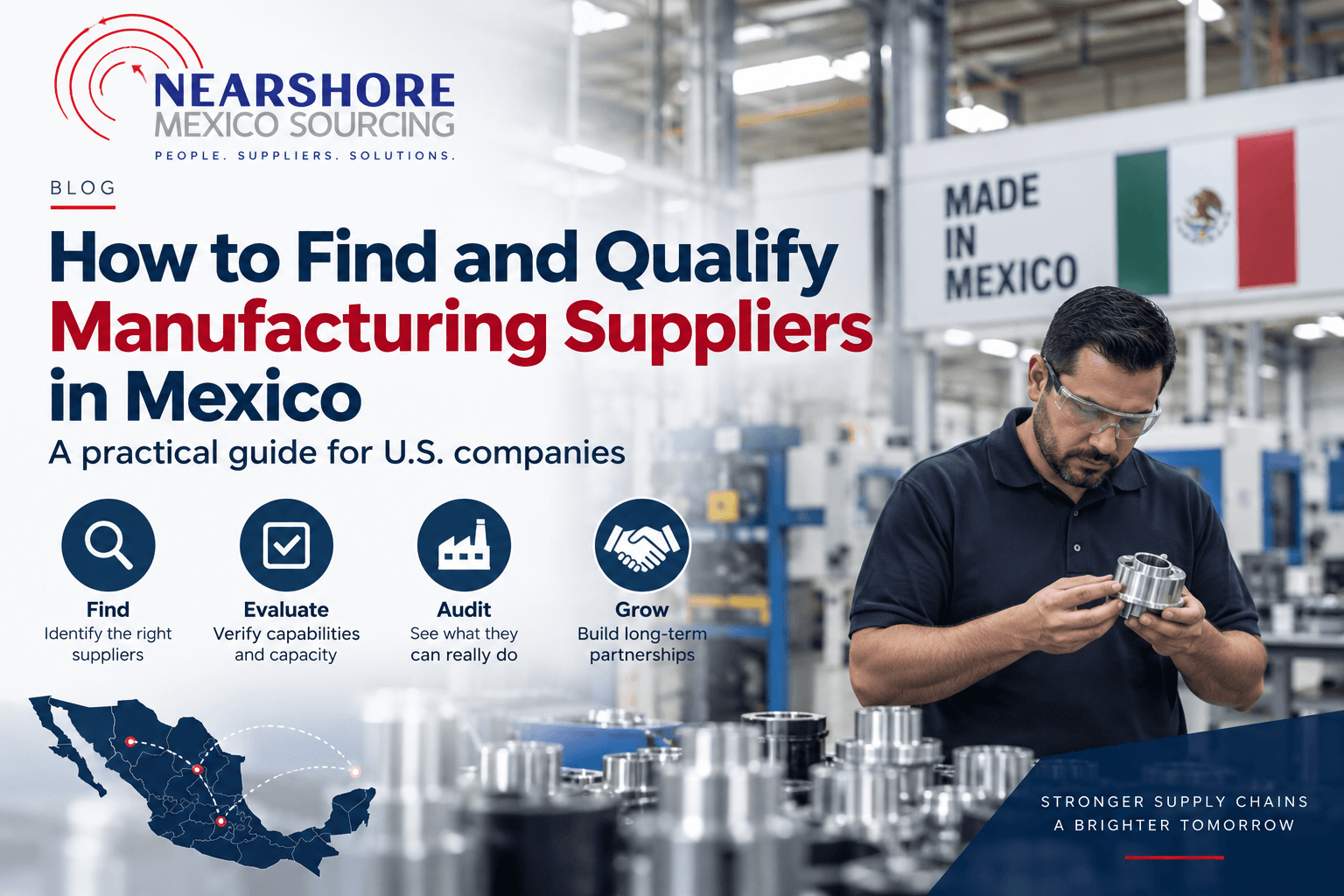
Finding a manufacturer in Mexico is relatively easy.
Finding the right manufacturer is a completely different exercise.
A Google search can produce dozens of Mexican companies that appear to manufacture the product you need. But a website or capability statement does not tell you whether a supplier has the right equipment, available capacity, quality systems, engineering capability, financial stability, or experience working with U.S. customers.
This is one of the biggest challenges companies face when they begin sourcing or moving production to Mexico.
Mexico has a large and increasingly sophisticated manufacturing base, but it is also highly fragmented. Many capable manufacturers have limited online presence, do not actively market themselves internationally, or specialize in very specific processes and industries.
That means successful supplier sourcing in Mexico requires more than finding companies. It requires identifying the right candidates, validating their capabilities, and then proving that they can actually produce your product to the required specifications.
At Nearshore Mexico Sourcing, this is the process we use when helping U.S. and Canadian companies develop manufacturing suppliers in Mexico.
1. Start With Your Manufacturing Requirements — Not With Suppliers
One of the most common mistakes is starting the supplier search before clearly defining what the supplier needs to manufacture.
Before contacting factories, you should have a reasonably complete understanding of:
- Product specifications
- Drawings and tolerances
- Materials
- Annual and monthly volumes
- Target production quantities
- Required production process
- Quality requirements
- Certifications
- Packaging requirements
- Delivery requirements
- Target cost
- Tooling requirements
- Expected ramp-up schedule
You do not necessarily need a perfect RFQ package before beginning the search. In many cases, the purpose of the initial supplier search is to determine what is technically and commercially realistic.
But the more clearly you understand your own requirements, the easier it becomes to distinguish between a supplier that genuinely fits your project and one that simply says, "Yes, we can do that."
2. Identify the Right Manufacturing Region
Mexico is not one single manufacturing market.
Different regions have developed strong industrial ecosystems around different industries and processes.
For example:
- Nuevo León and Coahuila have extensive metalworking, steel, machining and industrial manufacturing capabilities.
- Querétaro and the Bajío have strong automotive, aerospace, metalworking and industrial supplier networks.
- Jalisco has important electronics, plastics, food processing and industrial manufacturing capabilities.
- San Luis Potosí has developed a strong automotive, metalworking and general industrial base.
- The Estado de México has a broad and diversified manufacturing ecosystem, particularly for companies serving central Mexico.
The best supplier may not be located in the city you initially have in mind.
A supplier located 500 miles away with the right capabilities, capacity and cost structure can sometimes be a better choice than a supplier located 50 miles away that is overloaded or dependent on subcontractors.
Location should therefore be evaluated as part of the total supply chain rather than as an isolated factor.
3. Don't Rely Only on Google
This is where sourcing manufacturing suppliers in Mexico becomes more complicated.
Many excellent Mexican manufacturers have surprisingly limited digital visibility.
They may:
- Have an outdated website
- Have no English-language website
- Have little or no SEO presence
- Not advertise their full equipment list
- Rely primarily on existing customers
- Have little presence on international sourcing platforms
- Operate as privately owned or family-owned businesses
As a result, a Google search tends to favor companies that are good at marketing themselves rather than necessarily being the best manufacturing candidates.
This is one reason an experienced local sourcing partner can add value.
The objective is not simply to create a list of companies. The objective is to uncover companies that actually fit the technical and commercial requirements of the project.
4. Build a Longlist Before Choosing a Supplier
We generally recommend starting with a reasonable number of potential suppliers rather than immediately selecting the first company that looks capable.
Depending on the complexity of the project, this might mean identifying 10–20 potential candidates and progressively narrowing the field.
The initial screening should consider:
- Manufacturing process
- Equipment
- Materials
- Product experience
- Production capacity
- Quality certifications
- Export experience
- Location
- Approximate company size
- Existing customer base
- Engineering resources
- Communication capabilities
At this stage, you are not trying to determine which supplier will win the business.
You are trying to determine which suppliers deserve further investigation.
5. Verify What the Supplier Can Actually Do
A supplier saying it can manufacture your product is not the same as proving it can manufacture your product.
This is where supplier qualification begins.
For example, if you need CNC-machined components, you should look beyond the statement "we offer CNC machining."
You may need to understand:
- What machines they have
- Machine sizes and capabilities
- Number of machines
- Maximum part dimensions
- Tolerances
- Materials routinely processed
- Inspection equipment
- Programming and engineering capabilities
- Current machine utilization
- Experience with similar parts
The same principle applies to injection molding, metal fabrication, stamping, extrusion, welding, assembly, machining, plastics and other processes.
The question is not:
"Can you make this?"
The better question is:
"Show me how you would make this."
6. Evaluate Capacity — Not Just Capability
One of the most overlooked issues in supplier qualification is available capacity.
A supplier may have exactly the equipment you need but still be a poor choice if those machines are already running at full capacity.
Ask:
- How much available machine time do you have?
- What is your current utilization?
- What happens if our volume doubles?
- Do you operate multiple shifts?
- How quickly can you add another shift?
- Do you have bottleneck operations?
- Which processes are subcontracted?
- How much capacity is reserved for existing customers?
Capacity becomes particularly important when a project is expected to grow.
The supplier that works perfectly for 1,000 units per month may not be the right supplier for 10,000 units per month.
7. Conduct a Factory Audit
A supplier audit is one of the most valuable steps in the qualification process.
A factory visit allows you to compare what the supplier told you with what is actually happening on the production floor.
During an audit, you may want to review:
Production
- Equipment condition
- Machine utilization
- Production flow
- Material handling
- Preventive maintenance
- Work-in-process inventory
- Bottlenecks
Quality
- Inspection equipment
- Incoming inspection
- In-process inspection
- Final inspection
- Non-conformance procedures
- Traceability
- Calibration systems
- Quality documentation
Management
- Organization
- Engineering resources
- Production management
- Purchasing
- Customer service
- Export experience
Supply chain
- Raw material sources
- Critical subcontractors
- Tooling suppliers
- Outside processes
- Packaging
- Logistics
A factory audit should not simply be a tour.
It should answer a specific question:
Can this company reliably produce our product at the required quality, volume and cost?
8. Don't Ignore the Supplier's Financial Situation
Financial stability is another area that is often overlooked.
A supplier experiencing financial problems can create serious disruption even if its technical capabilities are excellent.
Depending on the size and importance of the project, it can be useful to understand:
- How long the company has been operating
- Approximate employee count
- Major customers
- Investment in equipment
- Growth plans
- Ownership structure
- Payment expectations
- Financial references where appropriate
You do not need to turn every supplier audit into an investment-bank due diligence exercise.
But if you are moving millions of dollars of annual production to a supplier, financial stability should be part of the decision.
9. Get Samples Before Moving Production
Never assume that a successful supplier audit means the supplier is ready for full production.
The next step should normally be samples, prototypes or first articles.
This gives both sides an opportunity to identify problems before significant production volumes are involved.
Depending on the product, this may include:
- Prototype parts
- First articles
- Tool trials
- Pilot production
- Dimensional inspection
- Functional testing
- Packaging trials
This stage is particularly important when moving an existing product from another country to Mexico.
A drawing may be correct while the manufacturing process still requires adjustment.
10. Compare Total Cost — Not Just the Piece Price
A Mexican supplier offering the lowest unit price is not necessarily the lowest-cost supplier.
Your comparison should consider total landed cost.
This may include:
- Unit price
- Tooling
- Packaging
- Freight
- Duties and taxes
- Inventory requirements
- Payment terms
- Scrap
- Quality costs
- Engineering costs
- Travel
- Supplier development
- Logistics management
This is particularly important when comparing Mexico with existing Asian suppliers.
A supplier in Mexico may have a higher factory price but still produce a lower overall cost once transportation, inventory, lead time and other supply-chain costs are considered.
The correct comparison is not:
Mexico price vs. China price.
It is:
Mexico total cost vs. China total cost.
11. Evaluate Communication During the Qualification Process
There is another useful test hiding inside the sourcing process:
Pay attention to how the supplier communicates before you award the business.
Do they answer questions clearly?
Do they understand your drawings?
Do they ask intelligent technical questions?
Do they provide information when promised?
Do they admit when they cannot do something?
Do different people at the company give you consistent answers?
These things matter.
A supplier relationship can last for years. Communication problems during the RFQ stage rarely disappear after the purchase order is issued.
12. Start With a Controlled Production Ramp-Up
Once the supplier has passed qualification, it is usually better to scale production progressively.
A typical sequence might look like:
- Supplier identification
- Initial technical screening
- RFQ
- Factory audit
- Sample or prototype
- First article approval
- Pilot production
- Initial production
- Performance monitoring
- Volume ramp-up
This approach gives both the buyer and supplier an opportunity to identify problems while the financial and operational exposure is still manageable.
The goal is not simply to transfer production.
The goal is to establish a supplier that can perform consistently over time.
13. Continue Managing the Supplier After Qualification
Supplier qualification is not the end of the process.
It is the beginning of the supplier relationship.
Once production starts, companies should establish clear performance metrics.
Depending on the project, these may include:
- On-time delivery
- Quality rejection rate
- Corrective-action response
- Lead time
- Cost performance
- Capacity
- Inventory
- Communication
Periodic supplier reviews and factory visits can also be useful, particularly for strategic suppliers.
A supplier that performed well during qualification should continue to be monitored as volumes increase.
What Should You Ask a Mexican Manufacturer Before Awarding Business?
If you are evaluating a potential supplier, here are some of the questions we recommend asking:
- What percentage of your current production is similar to our product?
- What equipment would you use to manufacture it?
- How much available capacity do you currently have?
- Which processes do you subcontract?
- Who are your major customers?
- What quality certifications do you currently maintain?
- What inspection equipment do you have?
- What is your typical lead time?
- What are your minimum order quantities?
- What materials do you normally purchase locally?
- What is your experience exporting to the United States?
- Can you provide references from comparable customers?
- How do you handle quality claims?
- How quickly can you increase production?
- Who will be responsible for our account?
The answers are important.
But the quality and consistency of those answers are also valuable information.
When Should You Use a Sourcing Consultant in Mexico?
Not every company needs a sourcing consultant.
If you already have a strong Mexican procurement organization, understand the local manufacturing landscape and have established supplier relationships, you may be able to manage the process internally.
The challenge is different for a U.S. company that has never sourced from Mexico.
In that situation, the biggest problem is often not finding a supplier.
It is knowing which suppliers to trust.
A local sourcing partner can help with:
- Supplier identification
- Supplier pre-qualification
- Factory visits
- Capability audits
- RFQs
- Price benchmarking
- Technical communication
- Sample coordination
- Production follow-up
- Quality issues
- Logistics coordination
- Supplier development
The objective should not be to create another layer between the buyer and manufacturer.
The objective should be to reduce the time, risk and uncertainty involved in establishing the relationship.
The Bottom Line
Mexico has a large and capable manufacturing base, but successful sourcing requires more than finding a factory and requesting a quotation.
The right supplier needs to fit your technical requirements, quality expectations, production volumes, commercial objectives and long-term growth plans.
The process is therefore best viewed as a funnel:
Find → Screen → Audit → Sample → Validate → Produce → Scale
Skipping one of these stages can create problems later.
For companies in the United States and Canada, Mexico can provide an attractive platform for reducing supply-chain distance while gaining closer access to suppliers, engineering teams and production.
But the value of nearshoring depends heavily on supplier selection.
The right Mexican manufacturer can become a long-term strategic partner.
The wrong one can turn a promising nearshoring project into months of delays, quality problems and unnecessary cost.
At Nearshore Mexico Sourcing, we help international companies identify, evaluate and develop manufacturing suppliers in Mexico. We work on behalf of the buyer and can support projects from the initial supplier search through qualification, production and ongoing supplier management.
If you are looking for manufacturing suppliers in Mexico and don't know where to start, contact us. We can help you identify the right manufacturing region, develop a qualified supplier shortlist and validate potential partners before you commit to production.
Frequently Asked Questions
How do I find a manufacturer in Mexico?
You can identify Mexican manufacturers through industry directories, trade associations, industrial clusters, referrals, trade shows and local sourcing networks. However, identifying a company is only the first step. Its manufacturing capabilities, capacity, quality systems and commercial fit should be validated before awarding business.
How do I verify a Mexican supplier?
Supplier verification can include a review of manufacturing capabilities, equipment, certifications, customer references, financial stability, production capacity and quality systems. A factory audit is often an important part of the qualification process.
What are the best manufacturing regions in Mexico?
There is no single best manufacturing region for every product. The appropriate location depends on the manufacturing process, supplier ecosystem, labor availability, logistics requirements and customer location. Major industrial regions include Nuevo León, the Bajío, Jalisco, San Luis Potosí, Coahuila and the Estado de México.
Should I visit a Mexican factory before placing an order?
For strategic or high-value manufacturing projects, an on-site visit is highly recommended. A factory visit provides information about equipment, production flow, quality systems, capacity and management that is difficult to establish remotely.
How long does it take to qualify a Mexican supplier?
The timeline varies significantly depending on the product and industry. A simple component may be qualified relatively quickly, while tooling, certifications, testing and complex production transfers can take considerably longer.
What is a supplier audit?
A supplier audit is a structured assessment of a manufacturer's capabilities, production processes, quality systems, equipment, capacity and management. Its purpose is to determine whether the supplier can reliably meet the buyer's requirements.
Is manufacturing in Mexico cheaper than China?
There is no universal answer. Factory prices vary by product and process. Companies should compare total landed cost, including manufacturing, transportation, inventory, duties, quality and other supply-chain costs rather than comparing factory prices alone.
Do I need a sourcing agent in Mexico?
Not necessarily. Companies with an established Mexican procurement organization may not need one. For companies without local experience, a sourcing partner can help identify suppliers, conduct factory audits, manage communication and reduce the risks associated with supplier qualification.
What industries can be sourced in Mexico?
Mexico has significant manufacturing capabilities across industries including automotive, industrial equipment, metalworking, plastics, electronics, packaging, appliances, medical products, food-processing equipment and many other sectors. The appropriate supplier network depends on the specific manufacturing process and product requirements.
About Nearshore Mexico Sourcing
Nearshore Mexico Sourcing helps U.S. and Canadian companies source products and develop manufacturing relationships in Mexico.
Our services include supplier identification, supplier qualification, factory audits, sourcing, RFQ management, technical coordination, quality follow-up, production oversight and soft-landing support.
Our role is simple: we work on the buyer's side to help companies find the right manufacturing partners in Mexico.
